₫1 — One Dong
The artwork
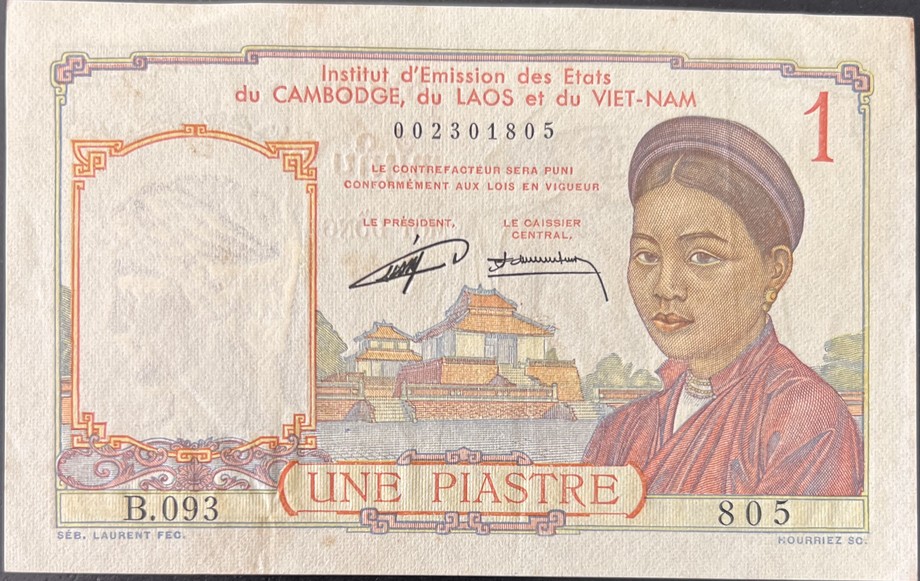
Front: A young Vietnamese woman fills the right-hand third: dark wound turban, pearl necklace and a small gold earring, in a high-collared red-brown tunic. Behind her stretches a walled complex of tiered, tile-roofed pavilions and gateways in the Nguyễn imperial manner of Huế. The issuer's name runs across the top in French, above the counterfeiting warning and the signatures of the President and Chief Cashier. UNE PIASTRE sits in a red cartouche below, flanked by serial block B.093 and 805.
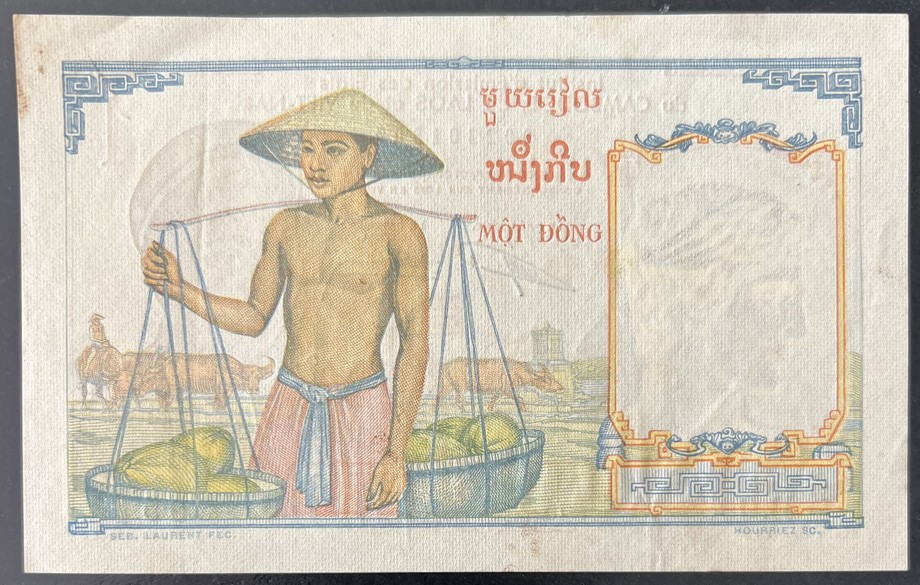
Back: A bare-chested young man stands in a conical palm-leaf hat, balancing a shoulder pole with two flat baskets of gourds, a blue sash knotted at his waist. Behind him a flooded paddy runs to the horizon with water buffalo and a herdsman riding one of them. To the right, the denomination in Khmer and Lao script above MỘT ĐỒNG in Vietnamese, beside an empty orange-framed watermark panel.
In circulation
The Institut d'Émission took over note issue for Cambodia, Laos and Vietnam from the Banque de l'Indochine in the early 1950s, with a separate language variant of each design for each state. The shared piastre was wound up after 1954; South Vietnam's National Bank notes, the Cambodian riel and the Lao kip replaced it.
Details
- IssuerInstitut d'Émission des États du Cambodge, du Laos et du Viet-Nam — Vietnam variant
- CurrencyDong (₫)
- DenominationOne Dong
- Collectedon the Vietnam journey, 2009
- Series1 Piastre / Một Đồng, undated; drawn by Séb. Laurent, engraved by Hourriez
- SignatureTwo: Le Président and Le Caissier Central
- SecurityPrinted warning: LE CONTREFACTEUR SERA PUNI CONFORMÉMENT AUX LOIS EN VIGUEUR