₣200 — Two Hundred Francs
The artwork
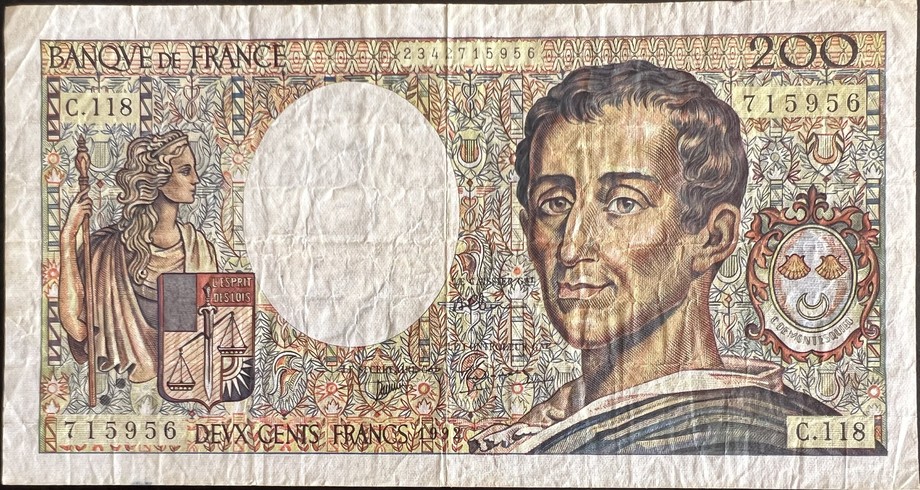
Front: Charles-Louis de Secondat, Baron de Montesquieu, in wig and coat, set against the dense floral arabesque that runs the width of the note — a deliberate echo of eighteenth-century decorative papers. "BANQUE DE FRANCE" and the value spelled out as deux cents francs, with 200 repeated in the corners and a clear oval reserved at one side for the watermark.
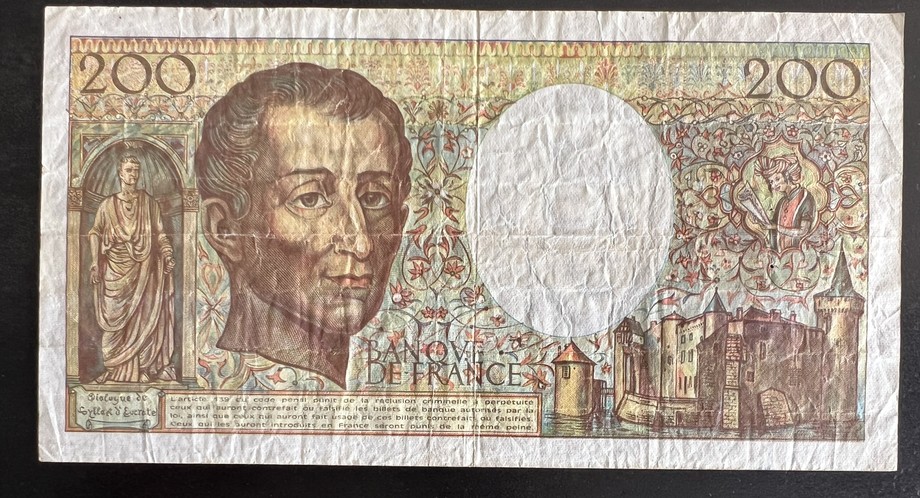
Back: Montesquieu once more, larger and in three-quarter view, floating over the same tapestry of flowers and vine. At the left, a robed classical figure stands in an arch, captioned "Dialogue de Sylla et d'Eucrate" after his essay. At the right, the Château de La Brède — his birthplace near Bordeaux — rises from its moat, towers and gatehouse mirrored in the water, with the counterfeiting warning set in a panel below.
In circulation
Introduced in 1981 and printed into the mid-1990s, it was the workhorse 200-franc note for a decade and a half. The Gustave Eiffel 200 francs replaced it from 1996, and the Montesquieu was withdrawn from tills soon after, ending altogether with the arrival of the euro.
Details
- CurrencyFranc (₣)
- DenominationTwo Hundred Francs
- Collectedon the France journeys, 1991–2019
- IssuerBanque de France
- Series200 francs Montesquieu, type 1981
- WatermarkHead of Montesquieu
- Dimensions172 × 92 mm