₣10 — Ten Francs
The artwork
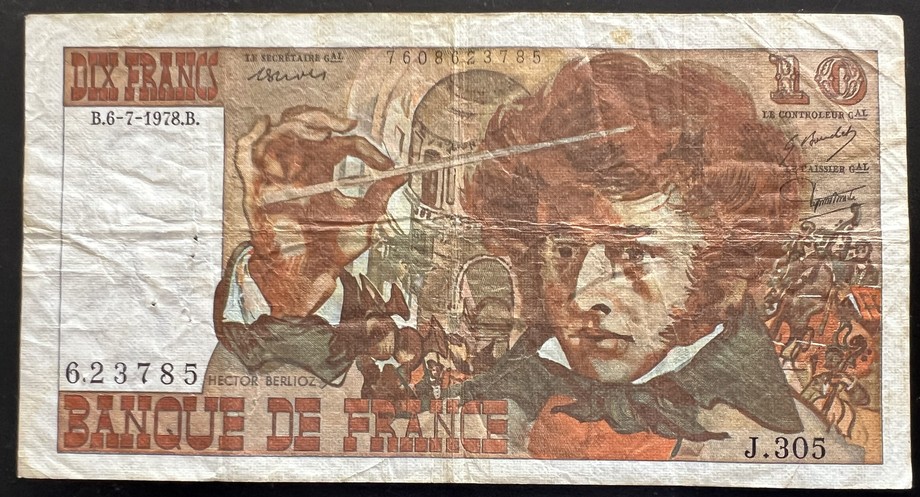
Front: Hector Berlioz in three-quarter view, wild-haired and stern, his name printed small beneath the collar. His right hand sweeps a conductor's baton across the width of the note, and behind him rise the arches and organ case of a church interior, with a cluster of players and instruments massed to the right. "DIX FRANCS" and "BANQUE DE FRANCE" are set in heavy orange capitals, with the date B.6-7-1978.B. at left.
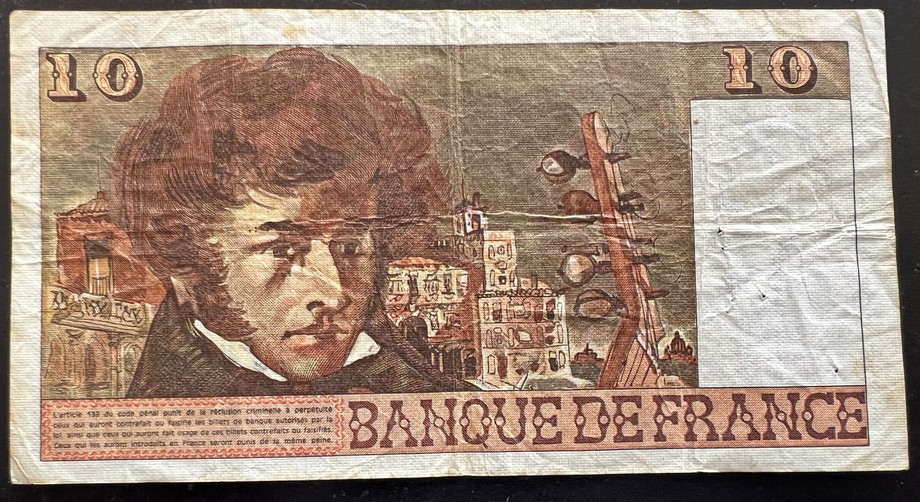
Back: The same head again, larger and turned the other way, set against warm Italian rooftops and tiled eaves — the Rome of his Prix de Rome years. A guitar leans across the right of the design, its neck and pegs picked out in fine engraved line, and smaller instruments hang above. "10" in each upper corner, the bank's name along the foot, and the counterfeiting warning in a small red-ruled panel at lower left.
In circulation
A 1970s workhorse: the smallest French note of its day, dated here to July 1978, near the end of the run. With the ten-franc value already carried by a circulating coin, the note was allowed to fade out rather than be replaced by a new design, and the fifty-franc note became the lowest paper denomination.
Details
- CurrencyFranc (₣)
- DenominationTen Francs
- Collectedon the France journeys, 1991–2019
- IssuerBanque de France
- Series10 Francs "Berlioz", dated B.6-7-1978.B., serial J.305 623785
- SignatureLe Secrétaire Général, Le Contrôleur Général and Le Caissier Général
- SecurityArticle 139 penal warning against counterfeiting printed on the reverse
- Dimensions140 × 75 mm